Google Search Console now also tracks Instagram, TikTok, YouTube and X
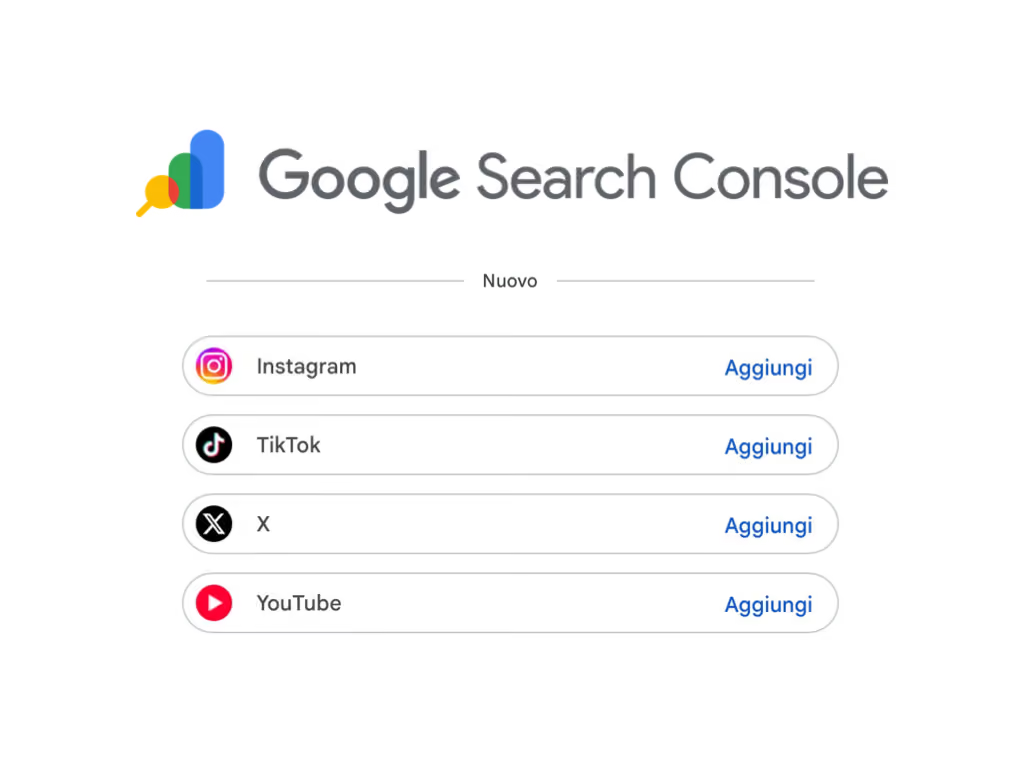
Until recently, Google Search Console only did one thing: show you how your website performed in search results. From July 2026, Google has added so-called "platform properties", which let you link your Instagram, TikTok, YouTube and X profiles too, so you can see which Google searches bring people to that content, as well as to your website.
For a business that invests time across several channels, without really knowing which one Google shows more often in search results, this is a change worth knowing about.
What platform properties are
A platform property is an asset separate from your website, even though it's linked to the same Search Console account. It doesn't replace your site property, it sits alongside it: you can have both your domain and your Instagram profile monitored, each with its own data, without the two being mixed together.
This means that if a customer in Ticino searches for your business name on Google and clicks on your Instagram profile instead of your website, that search used to stay invisible. Now, by linking the profile, that query and that click become data you can look at.
How to add a social profile to Search Console
You link it from the same property selector you already use for your website. Choose "Add property", select Instagram, TikTok, X or YouTube and complete verification, which can be done with direct access to the social platform or through an automatic connection if you already have a verified site property. This step has to be repeated for each individual account or channel you want to monitor, and after activation it takes a few days before the first data appears.
The feature is currently rolling out gradually, so it may not yet be visible on every Search Console account.
What data it actually shows
Once a profile is linked, Search Console shows impressions and clicks generated by Google Search, Google Discover and Google News, together with the specific search queries that brought people to that content. Average CTR, average position in results and the performance of individual posts or videos are also available, so you can see which specific piece of content picks up the most searches.
What it doesn't show
It's worth being clear about what this data doesn't cover, so as not to misread its value. There's no history: data collection starts from the moment you link the profile, it doesn't pull in past data. Followers, watch time or social interactions such as likes and comments don't appear, and remain visible only in the original apps. Google doesn't describe this feature as a ranking signal, so there's no indication that getting more traffic from Google to a social profile affects the site's ranking. And for now, Facebook and LinkedIn aren't supported.
Why it matters for understanding how people search for you
The practical value of this feature lies in separating out the search surfaces. Until now, if a business published content on both its website and Instagram or TikTok, it was hard to know which of the two channels Google showed more often to people searching for information about that business. With platform properties, you can compare, channel by channel, which queries bring people where, and avoid treating data as equivalent when it actually comes from different search surfaces.
For an SME in Ticino running both a website and one or more social profiles, this raises a concrete question: if people search for your name and Google shows your Instagram profile more often than your website, maybe it's time to strengthen the content on that channel, or work on your site so it competes better for the same searches.
How we'll use this for the clients we work with
In our SEO work, this feature becomes a new analysis tool alongside the data we already collect on the site: it lets us understand more precisely which channels really pick up customer searches, instead of relying only on general impressions or follower counts.
If you manage several social channels alongside your website and have never had a clear picture of which one really picks up Google searches, get in touch: we'll help you set up the monitoring and read this data in a way that's useful for your business.