Landing page or service page: which does your business need?
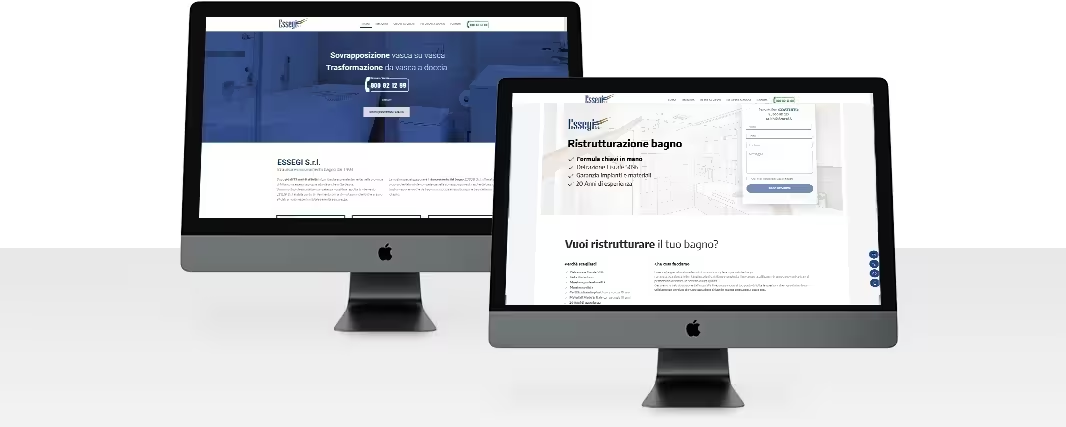
"We need a landing page" is one of the requests we get most often, and in half of those cases, once we dig into what's actually needed, it turns out the right answer is a well-built service page. The two things look similar, they both live on the website, they both present an offer, but they answer different questions and only work well if built for the right purpose.
What a service page is
A service page is part of the website's permanent structure. It describes in full what you offer, who it's for, how it works, and stays reachable from the navigation menu for the whole life of the site. People can arrive there in many different ways: searching on Google, clicking from the menu, coming from another blog post.
That's why a service page needs to work across several contexts at once. It needs to work for someone who doesn't know you at all and is still deciding whether you're the right business, and it also needs to work for someone coming back a second time to check a detail before getting in touch.
What a landing page is
A landing page is built for a much narrower goal: getting a specific action out of someone arriving from a particular source, usually an ad, an email campaign or a link shared in a specific context. Everything on the page is built around that single action: a form to fill in, a purchase to complete, a booking to make.
That's why a landing page strips away almost everything that could distract from that one goal: the navigation menu is often missing, links to other pages on the site are kept to a minimum or absent altogether, and the content only tells people what they need, given that they're already arriving with a precise expectation set by the ad or the message that brought them there.
The difference that actually matters
More than the length of the page or how polished the design is, what matters is where the reader is coming from, and how much they already know. Someone finding a service page through a Google search is often still comparing different options, and needs to understand the general context before acting. Someone clicking an ad promising a specific discount, on the other hand, arrives with a precise intention already in mind, and expects to find exactly what the ad promised, with no detours.
Building a landing page full of menus and links to other pages dilutes that intention. Building a service page as if it were a landing page, cutting every piece of context to push people towards a single form, leaves people who are still deciding whether to contact you without answers.
When you need a service page
It makes sense to invest in a service page when the goal is to be found over time by people searching for that kind of offer, to build trust with content that stays relevant for months, or to give other content on the site a stable reference point to link to, as we've done in many posts on this blog by linking them to their respective service pages.
We also covered this in the article company homepage: what a visitor needs to understand in the first few seconds, which looks at the same principle of clarity applied to the first point of contact with the site.
When you need a landing page
A landing page makes sense when you're launching a specific advertising campaign, a time-limited offer, an event, or when you want to precisely measure how many people, arriving from a specific channel, complete a specific action. Its value is measured by the conversion rate of that single page, not by organic ranking on Google over time, which is rarely its goal.
You can have both, and it often makes sense to
The two pages aren't mutually exclusive. A business can have a permanent service page, reachable from the menu and built for long-term visibility, and create temporary landing pages for individual advertising campaigns tied to that same service, perhaps with a different offer or message for each specific audience.
The problem arises when you try to make a single page do both jobs, perhaps because it seems simpler or cheaper. The result, almost always, is a page that doesn't rank well on Google because it's too focused on a single action, and that at the same time doesn't convert well for people arriving from an advertising campaign because they're distracted by too much contextual information.
A common mistake: using the homepage for everything
Many small businesses, without well-structured service pages or dedicated landing pages, end up sending every type of traffic to the homepage: people clicking an ad, people arriving from a specific search, people coming back for a detail. The homepage, designed to give a general overview of the business, doesn't properly answer any of these specific needs, and the result is often a lower conversion rate than it should be.
We also covered this in the article your website looks good, but does it actually bring in customers?, where the core problem is precisely the gap between what a page communicates and what visitors expect to find there.
How to decide for your business
Before asking whoever manages your website for "a landing page" or "a service page", try answering a simple question: where will the person reading this page come from, and what do they already know when they get there? If the answer is "from a Google search, without knowing much about you yet", you probably need a solid service page. If the answer is "from a specific ad, with a precise expectation already in mind", you probably need a landing page.
We take care of both needs as part of our websites service, building every page around who will read it and the purpose it needs to serve.
If you're not sure which of the two you need for the project you have in mind, get in touch: we'll look at the context together and tell you clearly which route makes sense.