A website for companies in Ticino: what to consider before you start
Building a website looks, on paper, like a simple project: you choose a provider, agree on a few pages, and publish the result. In practice, the companies in Ticino that actually get results from their website are the ones that asked themselves the right questions before starting.
This article covers the main things to consider before starting a new web project, regardless of who will build it.
Why not every company in Ticino needs the same website
A small professional practice, a craft business and an e-commerce store have very different needs. Yet it's common to see almost identical proposals, based on standard templates, regardless of the sector or the company's actual goals.
The Ticino market, small as it is on an international scale, is competitive and locally specific: customers look for nearby, reliable providers, often bilingual or multilingual given the proximity to Italy and the rest of Switzerland. A website designed generically for "any SME" is unlikely to pick up on these nuances.
Define the goal before the design
Before talking about colours, layout or features, it makes sense to answer a simple question: what should this website actually do?
The most common answers differ from one another and call for different approaches:
- generate contact or quote requests;
- sell products directly online;
- present the company to people already searching for it by name;
- support recruitment for new staff;
- centralise information that's currently only requested by phone or email.
A website built without a clear goal tends to become a middle ground that doesn't do any of these things well. Defining the goal first also helps work out a sensible budget: we cover this in more detail in the article on how much a website really costs.
Custom-built site or CMS-based?
One of the first technical decisions concerns the platform: a custom-built website or one based on a CMS (Content Management System) such as WordPress or similar solutions.
There's no answer that fits everyone. A CMS can be enough for a simple brochure site on a limited budget. A custom project makes sense when you need specific features, high performance or particularly structured content management.
We looked at this comparison in more detail in the article when a custom website is worth more than a CMS, useful for understanding which route suits your situation best.
Technical aspects not to underestimate
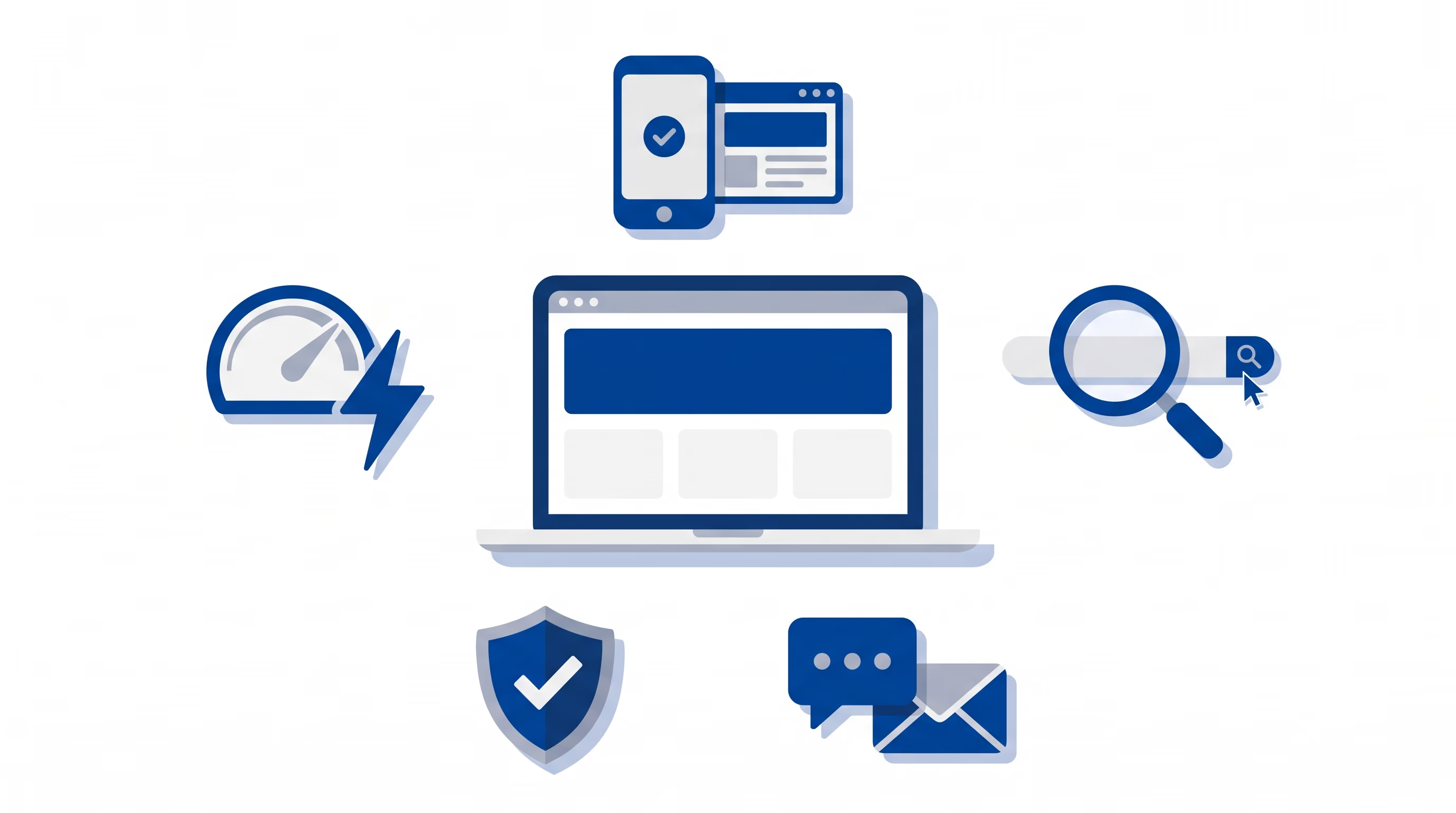
Behind a website "that works" there are several technical elements that are often taken for granted, but which directly affect how reliable the project is over time:
| Element | Why it matters |
|---|---|
| Hosting | Determines the site's speed, stability and uptime |
| Domain | Needs to be managed and renewed correctly, without depending on an unreachable third party |
| Professional email | An address consistent with your domain boosts company credibility |
| Backup and security | Protect the site from data loss or attacks |
| Technical support | You need someone to turn to if something goes wrong, even after delivery |
These aspects are part of what we offer with our websites service, which includes ongoing site management as well as the build itself.
SEO and visibility from day one
A common mistake is treating SEO as something to deal with "later on", after the site launches. In reality, many choices made at the design stage, such as page structure, titles and loading speed, directly affect the site's ability to be found on Google.
If your current website struggles to show up in search results, it's also worth reading why your website doesn't appear on Google, which explains the most common causes of this problem, often avoidable by setting the project up properly from the start.
User experience matters as much as design
A website can look visually polished and still be difficult to use: unclear menus, complicated contact forms, important information hidden away on secondary pages.
It's worth assessing user experience as a parameter in its own right, separate from aesthetics. The article UX/UI audit: finding out whether your website really offers a good experience explains what to focus on to stop good design from hiding problematic navigation.
Who looks after the site after launch
A published website isn't a finished project. Content to update, marketing campaigns to connect, small periodic changes: all of this requires ongoing management.
That's why, before starting a project, it also makes sense to ask who will handle digital marketing once the site is live, and how consistently.
Choosing who will look after the site afterwards too
The last aspect, often the most overlooked, concerns the kind of relationship you build with whoever builds your site. A supplier delivers a product and closes the project. A digital partner keeps working with the company afterwards, adapting the site as needs change.
Our approach, also described in the article why we analyse before we propose, always starts from an analysis of the company's situation.
Where to start
Before contacting a provider, try putting three things in writing: the website's main goal, the rough budget available, and who within the company will be responsible for updating it over time. These three answers alone already help rule out a lot of unsuitable proposals.
Request a free analysis
If you're thinking about building or redesigning your Ticino company's website and want to understand which approach actually makes sense for your situation, we can help you get clarity before you choose.
Request a free analysis: we'll assess your current situation and tell you which steps make sense to follow.