We have rebuilt our website: new design, new experience, new technology
After several years, we decided to rebuild our website.
The old one still worked. What had changed was us: the way we work had moved on, and the site itself had become very different from the one we started with.
Over time we had added new sections, features, integrations and systems to handle needs we had not foreseen at the start. Each addition had its reason. But, as often happens, it all started to add up.
At a certain point, then, we asked ourselves a very simple question:
Does it still make sense to keep adding things to the old website, or is it time to rethink it from scratch?
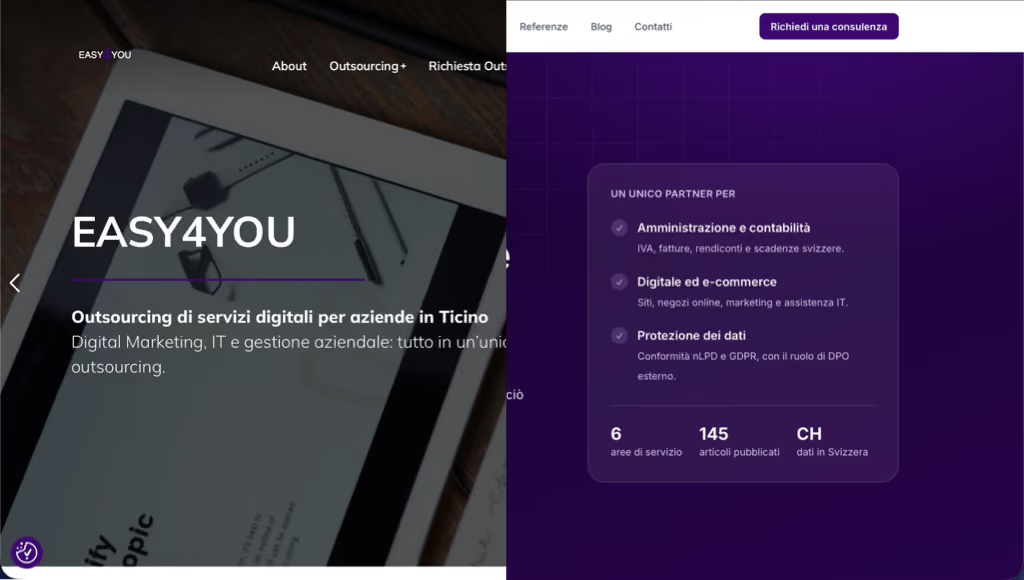
We chose the second option. The result is the new website you are now visiting: a new design, a new experience and, above all, a new technological foundation. We have moved from WordPress to Next.js.
It was about more than design
When people talk about rebuilding a website, they often think first of the look: changing colours, fonts, images, animations and layout.
For us, the new project had to be something more. We wanted to rethink how the site presents our business and how a visitor can find their way around our services.
The website needs to communicate quickly:
- who we are;
- what we do;
- which services we offer;
- how we work;
- which projects we deliver;
- why a company should choose to work with us.
That is why we redesigned the experience starting from the content and the goals, and only then from the visual side. The new design therefore comes from the need to make the site clearer, more direct and closer to the way we work.
Why did we leave WordPress?
Let us start with something important: there is nothing wrong with WordPress. It is an extremely widespread, versatile platform that suits a great many kinds of project.
For a blog, a company website with lots of content, an online shop or a project that needs to be managed every day by several people, a CMS can be a very sensible choice.
Our case, however, was different. Ours is mainly a brochure website: we do not have hundreds of products to manage, we do not need a complex catalogue, and we do not have a large editorial team that has to publish new content all the time.
Above all, our website has to explain who we are, present our services and show our work. So we began to ask ourselves whether we still needed the complexity of a CMS. The answer was no.
The problem was the complexity that had built up, not WordPress itself
Over the years we had added a number of features to the site. For every new need we found a solution: a plugin, an integration, a configuration, a new system or a customisation.
Individually, all these choices were reasonable. But over time the result had become a system made up of many different elements that had to coexist. And the more elements there are, the greater the chance that a change will affect something else.
Even apparently simple tasks could require more care: updating things, checking that everything still worked, looking for possible incompatibilities and, in some cases, testing directly on the live site.
It had become a way of working that no longer reflected who we are. We wanted more control over the project and, above all, to be able to develop and experiment without constantly having to touch the production site.
Updates, plugins and unexpected problems
Another aspect we considered was maintenance. An ecosystem based on a CMS, themes, plugins and integrations offers a huge range of possibilities, but it also introduces a number of dependencies.
An update to one plugin can, in some cases, create an incompatibility with another component. WordPress remains reliable, but the more components have to work together, the more complicated managing them becomes.
And when something goes wrong, the problem can become even more obvious. If you do not have direct access to the server or the infrastructure, you may have to go through whoever manages the hosting, restore a backup, track down the component that caused the error or fix the problem by hand. All of this can take time.
For our own website, then, we preferred to take a different approach.
We develop locally, test, and then publish
With the new website we have a much more controlled development workflow. New features are developed locally, without directly changing the site that users are visiting.
This means we can:
- develop a change;
- test it;
- check that the various parts of the site still work;
- check how it behaves on different devices and screen sizes;
- fix any problems;
- publish only when the work is ready.
It may sound like a technical detail, but for us it makes a big difference to the way we work. We can experiment, make changes and try out new solutions without having to use the live site as a test environment.
First we develop. Then we check. Finally we publish. It is a process that gives us more control and lets us work with greater peace of mind.
Why we chose Next.js
Once we had decided to start again from scratch, we looked at which technology best suited the project.
We chose Next.js because it lets us build the site exactly around our needs, rather than starting from a general-purpose platform and adding whatever is missing afterwards. This gives us more control over the structure of the site, its components, pages, interactions and performance.
The advantage, then, goes beyond simply «using a more modern technology». What really counts is being able to choose how each part of the project is built. For a site like ours, this freedom is particularly appealing.
A brochure website does not need to be complicated
Our website has to do a few things, and do them well. It has to be fast. It has to be clear. It has to work well on desktop and mobile. It has to describe our services. It has to make it quick to understand who we are. It has to guide a potential client towards getting in touch.
We do not need hundreds of features. And that is exactly why we preferred not to build a structure more complex than necessary. A custom solution lets us keep the project focused on what is actually needed.
More control also means more freedom in the design
One of the things we cared about most was being able to rethink the interface completely.
When you work on a foundation built specifically for the purpose, the design does not have to fit into an existing theme or structure. We can design the components around the experience we want to create: navigation, typography, spacing, animations, interactions, calls to action and layout can all be conceived as parts of a single system.
This has allowed us to give the new site a more distinct identity. A «prettier» website was never the goal in itself: we wanted a website that communicated better who we are.
Performance and lightness
Another goal of the new project was to have a website that is as light and fast as possible. A brochure website should not load resources and features it does not use.
Starting from scratch, we were able to decide which components to use, how to organise the pages and how to handle the loading of resources. Next.js gives us more control over these aspects and lets us build a modern experience while keeping the architecture focused on what the project needs.
For us, performance is designed in from the start, together with the rest of the site.
It is not a contest between WordPress and Next.js
Our choice does not mean that from now on we think every website should be built with Next.js. That would be the wrong conclusion: the best technology is the one that best suits the project.
WordPress can be the ideal solution for a company that needs to manage lots of content, products, users and features through a CMS. A custom website, on the other hand, may make more sense when:
- the project is mainly a brochure site;
- there is relatively little content;
- the design matters;
- performance is a priority;
- not many editorial features are needed;
- you want more control over the code;
- the site has to evolve in a highly customised way.
That is exactly our situation. That is why we chose Next.js.
Our website is also an example of our approach
There is a reason why we devoted so much time to redesigning our website: it is one of the tools through which we present our work.
If we advise our clients to start from their goals, analyse the user experience and choose the most suitable technology, we have to be the first to do so on our own project.
So we followed the same principle we apply to our clients' projects: first understand what is needed, then design the experience, and finally choose how to build it.
We did not choose Next.js simply because we wanted to use a different technology. We chose it because, for this specific project, it lets us work better.
An investment that goes beyond the new design
Rebuilding a website takes time and investment. The simplest solution would have been to keep the existing structure, change the theme, update some content and carry on working with the system we already had.
Instead, we chose to invest a little more to build a completely new foundation. Why?
Because the cost of a website should not be judged only by how much it costs to put online. You also have to consider how much it costs to maintain it, change it, develop it further and work on it in the years that follow.
In our case, we felt that a simpler, more controllable and customised foundation was a sensible investment.
Welcome to the new website
The new website is a new starting point. We have changed technology, rethought the design and simplified the way the project is developed and maintained.
Above all, though, we have tried to do one very simple thing: build a website that makes sense for us. Not a system full of features we do not use. Not a design chosen only because it is fashionable. Not a technology chosen for the sake of using it.
Instead, a tool built around our needs, our services and the people we want to reach.
And this, in the end, is the philosophy we want to bring to our clients' projects too. Technology comes after the project: first you need to understand what is really needed, then you build.