Increase your traffic with multilingual translation
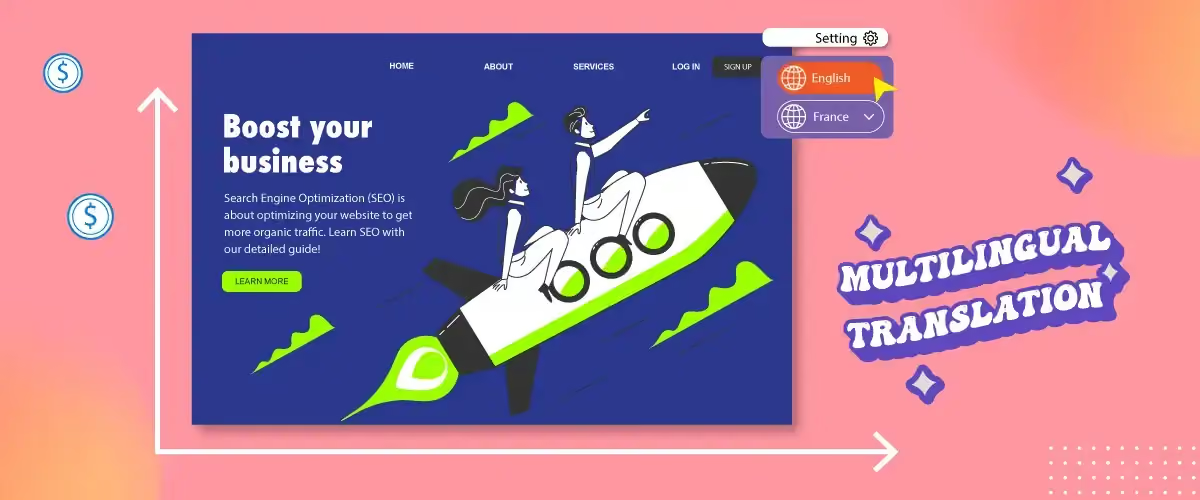
Multilingual translation is one of the most direct ways to increase traffic to a website or blog: extending your online presence to more languages means reaching a much larger audience and picking up users who would otherwise never find your content. It improves the experience for non-native speakers and brings in visitors from other markets through search engines.
The benefits of more visitors on your website
Before looking at ways to bring more visitors to your blog, it is worth considering the benefits that come from more traffic to your website.
More potential customers
More traffic exposes your business to a wider audience of people who could become customers. The more people visit your site, the greater the chances of converting them. With a wider reach, you have more opportunities to show your products/services to new potential customers. Choose targeted content and promotions to attract the potential customers who visit your site.
Greater brand awareness
The more people visit your website, the more aware they become of your brand, your products or your services. This greater exposure matters a great deal when building brand recognition. When people are familiar with your brand, they are more likely to trust it, recommend it to others and come back to it in future. Brand awareness often leads to brand loyalty, which is invaluable for a company's long-term success.
Search engine optimisation
Most search engines take traffic into account when deciding where websites rank. More organic traffic from search can improve your site's SEO ranking. By attracting more visitors directly from search engines, you can build authority signals that tell search engines your content is valuable, reliable and deserves a higher position. The most visited content tends to rank better in the SERP.
More data and feedback
More traffic gives you more data and feedback from users, which you can analyse to improve your products, your content and the user experience. With more visitors on your site, you gain useful insight into their behaviour, needs, pain points and preferences, which lets you refine what you offer. User data is essential for the future development of the business.
Greater credibility
A popular website with a large number of visitors gives the impression that your business is thriving and well established. This builds trust and credibility. Today people often judge how reliable a company is by how professional its website looks and how much traffic it manages to attract. A site with high traffic creates a perception of success. High traffic makes potential customers feel confident about buying from you and doing business with you.
How to bring more visitors to your blog/site by translating it into several languages.
Having looked at the different multilingual translation methods you can choose from, we will now go through the steps to follow to increase your blog/site traffic using this practice.
Understanding your target audience and keywords comes first
To increase your blog/site traffic through multilingual translation, the first step is to understand the target audience for each language or country. You can start by researching and analysing the demographics, behaviour, content preferences and popular topics of that audience.
Find out about the latest developments on your blog's subject in each country you are interested in. Also identify the keywords and phrases your audience searches for most often in each language. This information will help you decide what kind of content should be translated.
By understanding the target audience for each language or country, you will be able to create relevant translated content, increasing the chances of catching the interest of readers abroad.
You can identify the keywords that matter using various research tools, for example:
1. Ahrefs
2. Semrush
3. Google trends
Choose the right translation approach
To produce multilingual translations, you need a translation method for websites and blogs. Broadly speaking, website owners commonly use three types of method, and you can choose which of the following three suits you best.
Browser translation
This automatic translation feature is available in some web browsers such as Google Chrome, Mozilla and so on. It lets website visitors translate the content of a web page into the language of their choice with a single click. Although it is simple, the quality of browser translation is often poor and does not take grammatical and cultural nuances into account. It also does not support SEO optimisation.
Human translation
This means having the blog content translated by professional translators or native speakers of the target language. The quality of the translation is much better because it takes context, linguistic style and nuance into account. The drawback of human translation, however, is that it takes longer. As a result, the cost of hiring a professional translator is fairly high. This method is not suitable for websites that are still starting out or are small in scale.
Machine translation
This method uses artificial intelligence and machine learning technology to translate content automatically. Costs are relatively lower and the translation process can be carried out quickly. Several translation services already offer translation editing features to improve the results and features for working with translators, and they also support SEO optimisation. Machine translation is therefore the right solution, as it lets you translate automatically while also working alongside human translation.
Translate every element
Translation should be applied consistently to every element of the site, including menus and buttons, as well as to the articles. Some of the things that need translating include:
– Widgets
– Navigation menus
– Categories
– Tags
– Meta descriptions
– Alt text and other elements.
Translating every element of the blog consistently makes life easier for readers. Readers from abroad want to move around the blog easily without coming across a mix of languages. Make sure the blog's menu and navigation are translated so that they can find relevant content.
If your blog is an e-commerce site, translate the checkout and cart pages too. These pages are crucial for keeping sales conversions going.
Translating every element of the blog may take extra effort, but it will have a significant impact on the visitor experience. Visitors will feel more at ease using your blog, which will lead to more traffic.
Make use of the most advanced technology and tools.
Translating blog content into several languages calls for reliable tools and technology that simplify the process, speed it up and ensure accurate results. Translation plugins are a key aid here, as they let you manage multilingual content in a structured way directly from the site's content management system.
There are two main types of translation plugin:
- Plugins for manual translation , which give you full control over the translated texts.
- Machine translation plugins , which translate content immediately, cutting time and manual work.
Machine translation plugins are often the preferred choice, especially for blogs and sites that change frequently, because they let you publish multilingual content quickly and keep the site up to date.
The most widely used solutions include:
- Linguise, which offers automatic content detection, fast translations, a full dashboard with a live editor and statistics on translated pages.
- WPML, ideal if you want advanced management of manual and machine translations on WordPress.
- Polylang, a flexible solution for creating multilingual content with a good level of editorial control.
- Weglot, which lets you translate and publish a site in several languages quickly, with a simple, SEO-friendly interface.
These tools make managing blog content more efficient and give international users a consistent experience.
Translating a blog does not mean settling for a word-for-word translation, though. It is essential to localise the content, adapting it to the cultural and linguistic context of the target audience. Localisation can include:
- adapting formats such as dates, currencies and units of measurement;
- adjusting the linguistic style to suit the country;
- adapting to specific writing formats, such as right-to-left languages (Arabic, Persian, Hebrew);
- respecting local cultural norms and customs to avoid misunderstandings.
Blog content should come across as written specifically for readers in the target country, which improves understanding, relevance and the emotional connection with visitors. Proper website localisation makes the blog more accessible, easier to understand and more competitive internationally.
Putting multilingual SEO in place.
To increase your blog's traffic, your site's content needs to appear on the first page of Google. You can achieve this by applying multilingual SEO consistently.
Here are some tips for setting up multilingual SEO and increasing your blog's traffic through multilingual content.
Identify your target keywords
Find the most popular phrases and keywords that native speakers use in each language/country to search for related topics. Make the best use of these keywords in your content.
URL/subdomain structure
Use a specific domain or subfolder with language/country codes so that search engines can tell which version of the content is relevant. This will help improve your blog's visibility.
Submit a multilingual sitemap:
Make sure you submit a multilingual sitemap so that search engine crawlers index all of your blog's content. That way, your content will be easy for users to reach.
Use hreflang tags
Hreflang tags are HTML codes that signal to search engines the language of a web page and the geographical region it targets. These codes help search engines work out in which language and country your content should be shown.
Optimise the page content
Make sure you optimise your content, including titles, headings, meta descriptions and keyword distribution. Good SEO optimisation of every piece of content will increase the chances of your blog appearing on the first page of Google.
Keep the quality consistent across languages
One important tip is to keep the quality of the translated blog content consistent across the different languages. Consistent translation in each language ensures that terms are used correctly and uniformly in all translations of the content.
Before publishing, translated content should be checked by native speakers or translators of the target language to ensure the quality and accuracy of the translation.
This consistency must also apply to brand names and technical terms. Special phrases like these are usually left in the original language. To do this, you can use the translation exclusion feature in the translation tools you use.
By following these steps, you will be able to keep quality standards high and translate your blog content consistently into the different target languages. This matters if you want to offer the same pleasant reading experience in every language version you provide.
Monitoring and evaluating performance
Once you have finished translating your blog content, it is important to monitor and analyse how it performs. To do so, it is advisable to use web analytics tools such as Google Analytics, which let you track traffic, engagement metrics and conversions for each translated version.
By analysing the data collected, you will be able to identify which blog content in a particular language performs well and which performs less well. Content with high traffic shows that the translation is attracting readers, whereas content with a weak response may need a better-quality translation.
With careful monitoring and accurate analysis, you will be able to keep optimising your multilingual content strategy to get the best results. That way, traffic and interest from readers around the world will keep growing.
Keep your content up to date
Keeping content up to date at all times is essential. Check that all language versions are kept in sync and contain the latest information. This applies to the language and also to the trends and topics followed in each country.
That way, you will be able to produce translated content that matches readers' current interests. Carry out keyword research for each language regularly, to make sure your content matches what people are searching for.
Keeping multilingual content up to date is very important if you want to offer a consistent reading experience and provide relevant information in every language version.
Conclusion
Translating your content is an effective strategy for increasing your site's traffic, improving multilingual SEO and reaching new audiences. Good content localisation, covering texts, meta information and navigation, makes your site more accessible and more competitive internationally.
If you would like to optimise your site with professional translations or put integrated multilingual solutions in place to improve visibility and traffic, write to us: we can take care of choosing the tools and managing multilingual campaigns.